

Finding Helen and Michael gave names and faces to the people from whom I came. The empty spaces in my biological family tree began filling with parents, grandparents, brothers, histories, talents, and stories. I could finally trace parts of myself backward and recognize that qualities I carried had existed in other people before they appeared in me.
Yet finding my biological parents did not answer the question that had followed me since childhood.
Who was I?
More importantly, was the person I already was acceptable?
I grew up knowing that my parents loved me. They provided a stable home, encouraged my interests, attended events, and gave me opportunities. I played tennis, took piano lessons, became involved in school, and eventually served as editor of the high school newspaper. My parents had waited years to build a family, and once my sister and I arrived, they committed themselves to raising us.
Love was present.
Acceptance was more complicated.
There is a difference between being loved and feeling fully accepted. A person can receive care, protection, opportunity, and encouragement while still sensing that important parts of who they are make the people around them uncomfortable. The message may never be stated directly. Children rarely require direct statements. They notice what concerns the adults around them, which qualities receive praise, which differences require explanation, and which parts of themselves seem to disappoint or confuse the people whose approval matters most.
I began noticing those messages early.
I was a very small child. Throughout elementary school, I was probably the smallest person in most of my classes. Other children called me “Shrimp” during my first few years of school. Children are remarkably efficient at identifying differences, and once they find one, they can turn it into an identity before the child carrying it has developed one of his own.
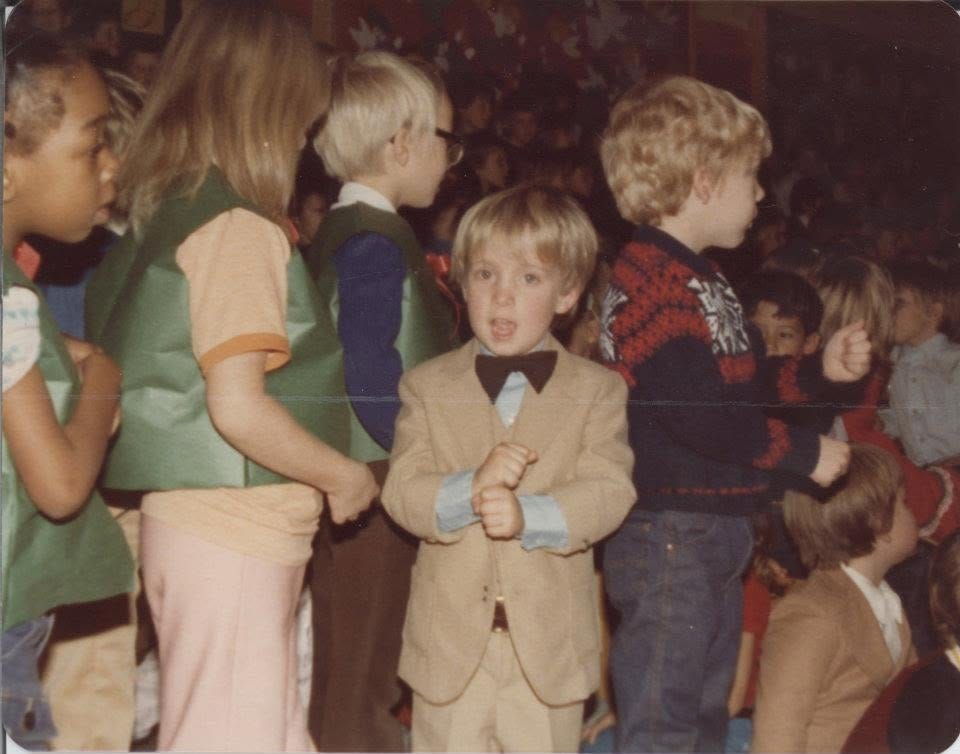
Shrimp was not simply a nickname. It became a reminder that I occupied less physical space than the other boys. I was shorter, more petite, and less physically imposing. Whatever confidence I might have developed had to compete with the daily evidence that I did not look like them.
Home should have been the place where my size stopped mattering. Instead, I learned that my father was concerned about it too.
When I was young, perhaps in early elementary school or even before, my parents took me to a doctor because my father worried about my small stature. I do not remember every detail of the appointment, but I remember the story and the decision that followed. One possibility discussed was using human growth hormone in an attempt to make me taller.
The doctor offered another possibility.
I could simply be a small boy.
And that could be perfectly fine.
I have returned to the wisdom of that statement many times.
The doctor was not dismissing my father’s concern. He was offering a radically different way to interpret the situation. My size did not necessarily indicate a problem. My body did not automatically require correction. I might grow, or I might remain small. Either way, I could still be healthy, capable, complete, and worthy.
Thankfully, my parents followed that advice and did not pursue growth hormone.
Still, the underlying message remained with me. My father had looked at my body and wondered whether something should be done to change it. The doctor had looked at the same child and suggested that perhaps the child did not need to be changed at all.
Perhaps he could simply be small.
Perhaps small did not mean broken.
As I grew older, size became connected to another set of expectations. My father came from a generation and culture with particular ideas about masculinity. Boys were expected to behave in recognizable ways. They were supposed to be physically confident, assertive, interested in girls, and comfortable pursuing them. A son who did not display those qualities strongly enough could create concern.
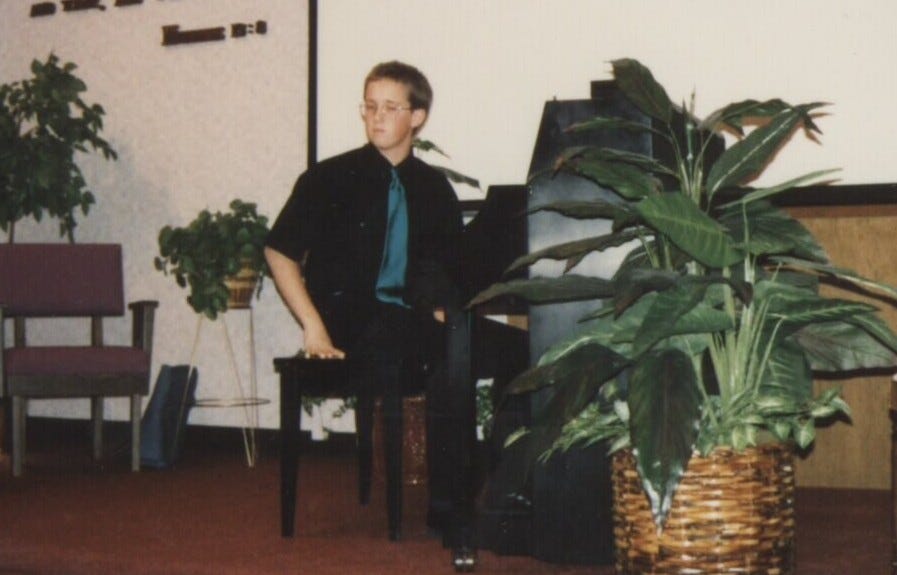
I was interested in girls, but I was shy. I was more comfortable with computers, school, music, sports, and ideas than with performing a version of masculinity for other people. I played tennis and took piano lessons. I could be social and funny around people who knew me, but I did not always reveal those qualities at home. I was thoughtful, curious, and often much more comfortable observing before I participated.
None of those qualities made me less masculine.
At sixteen, however, I received a disturbing demonstration of how concerned my father had become that I was not behaving as he believed a young man should.
My father rarely drove me to piano lessons, but one day he did. On the way home, he missed the turn that would have taken us back toward Carter Lake and continued driving toward downtown Omaha. I asked where we were going. His answer made it clear that he intended to force me toward an adult experience because he was concerned that I was not pursuing girls or demonstrating masculinity in the way he expected.
He was taking me to a prostitute. Looking back, I believe he was worried that I might be gay, or at least worried that I was not developing into the kind of young man he thought I should become. To him, this may have seemed like a solution. To me, it felt like proof that something about who I was had become a problem that needed fixing.
I immediately refused.
I told him that if he continued driving downtown, I would open the car door and jump out.
I meant it.
He turned around.
Looking back, I recognize something in that sixteen-year-old boy that I did not fully appreciate at the time. I did not possess much self-confidence, and my self-concept was fragile, but some part of me still understood that a boundary had been crossed. Even before I knew how to accept myself, I knew there were parts of myself I needed to protect.
I was willing to jump from a moving car before allowing someone else to determine who I had to become.
That memory is painful, but not because it caused me to question my masculinity or identity. It is painful because the person driving the car was my father. Home should have been the place where I was allowed to develop in my own time. Instead, the concern I experienced among other children had followed me into my family. My size had worried him when I was young. My expression of masculinity worried him when I became a teenager.
The repeated message seemed to be that I was not developing into the son he expected.
My parents also occasionally gave me Sports Illustrated swimsuit issues for Valentine’s Day. I have never fully understood the reasoning, but I suspect they were intended to encourage an interest they believed I was not demonstrating strongly enough. The gesture may have seemed humorous or harmless to them. To me, it became another suggestion that my interests and behavior required adjustment.
I did not need help becoming more masculine.
I needed the freedom to become myself.
That freedom is much harder to claim when a child is uncertain whether he was wanted in the first place.
My father told one particular story many times, sometimes directly to me and sometimes to other people while I listened. When my parents met with the adoption counselor, they were asked why they wanted a baby. My mother offered all the answers one might expect from a woman who deeply desired children. She wanted someone to love, nurture, and raise. She wanted a child and believed motherhood would make her life feel more complete.
When the counselor asked my father the same question, his answer was different.
He said that he did not particularly want a baby, but his wife did, so he was there to support her.
I believe my father told that story because he thought it made him sound like a devoted husband. The message he intended may have been that he loved his wife enough to help fulfill her dream even though parenthood had not originally been his own.
That was not the message I heard.
I heard, “I did not want you, but your mother did.”
Children do not always hear intentions. They hear words, and then they build meaning around them.
Every time my father repeated the story, I heard another reminder that my place in the family had depended upon my mother’s desire rather than his. Perhaps he grew to want and love the child who arrived. Perhaps his original reluctance became irrelevant once I was home. Those possibilities can be true while the words still leave a mark.
Decades later, after finding Helen, I received another version of the same message.
Helen told me that she had intentionally become pregnant because she wanted to experience pregnancy. She wanted to know what it felt like. She was young, rebellious, curious, and experimenting with her life. Motherhood, however, was not necessarily what she wanted.
Again, I understand that her statement was about her life, her curiosity, and the decisions of a young woman trying to define herself. I appreciate her honesty, even when the truth she offered was unconventional or difficult. She did not attempt to rewrite the circumstances of my conception into a romantic story simply because that version might have been easier for me to receive.
Still, the child inside the adult heard something else.
My biological mother wanted the experience of pregnancy, but not necessarily the child who followed.
My adoptive father wanted to support his wife, but not necessarily the child she wanted.
The conclusion almost assembled itself.
My existence had been desired as an experience by one person and accepted as an obligation by another.
No one needed to say, “You were not wanted.”
The stories seemed to say it for them.
Those stories mattered because they joined the other messages I had received. I was too small. I was not behaving in sufficiently masculine ways. My biological mother wanted to experience pregnancy. My adoptive father had been willing to become a parent because his wife wanted a child.
When enough messages point in the same direction, a child begins to believe they represent the truth.
Perhaps that is why I struggled with self-concept and self-esteem for so much of my life. Self-concept is the story we tell ourselves about who we are. Self-esteem reflects the value we assign to that person. It is difficult to build either one securely when the people at home appear uncertain about whether the person you are is the person they wanted.
My father openly stated that he did not believe in self-esteem. He seemed to view it as unnecessary or perhaps as something that could encourage weakness, indulgence, or an inflated opinion of oneself. I came to understand it differently.
Healthy self-esteem does not mean believing we are better than everyone else. It means believing we possess worth that does not disappear when we fail, disappoint someone, look different, or refuse to follow an expected path.
Without that foundation, approval becomes addictive. Achievement becomes evidence that we deserve our place. Usefulness becomes a substitute for identity. We learn to solve problems, accept responsibility, meet expectations, and carry whatever other people place on our shoulders because being needed feels safer than simply being loved.
I became very good at being useful.
I was dependable. I worked hard. I achieved things. I solved problems. I accepted responsibility. I built a career around being the person people called when something needed to be fixed.
What took much longer was learning how to value myself when I was not fixing anything for anyone.
It is difficult to love and accept yourself when you did not consistently feel unconditionally accepted at home. A child learns self-love partly through reflection. We first see ourselves in the eyes of the people raising us. If their expressions communicate delight, curiosity, and acceptance, we begin to believe we are worthy of those things. If their responses communicate concern, disappointment, confusion, or the desire that we become something else, we may spend years trying to correct a person who was never broken.
The doctor had understood something that the rest of us had not.
Let him be small.
Over time, I expanded those words.
Let him be shy.
Let him take piano lessons.
Let him play tennis.
Let him love computers.
Let him be funny in ways his family does not always understand.
Let him become interested in relationships in his own time.
Let him define masculinity for himself.
Let him ask unusual questions.
Let him follow curiosity.
Let him be different.
Let him be Jeff.
For many years, I believed acceptance would arrive after I became sufficiently accomplished, useful, successful, or understandable. I treated belonging as something I needed to earn by becoming whatever the people around me required.
Eventually, I recognized the impossible bargain I had made.
Acceptance purchased by abandoning myself was not acceptance of me.
It was approval of a performance.
That realization brought me back to the color rainbow.
When Annabelle described her favorite color that way, my first instinct had been to correct her. A rainbow was not a single color. The question expected one familiar answer. She refused the limitation without even realizing she was doing it.
The beauty of a rainbow exists because each color remains itself. Red does not apologize for being red. Blue does not try to become green because green appears more acceptable. None of the colors competes to prove that it belongs. Each occupies its place, distinct and complete, while contributing to something larger.
People deserve that same freedom.
Whatever your body looks like, however you identify, whoever you love, whatever you believe, and however you experience the world, you should not have to erase your authentic self to become acceptable to someone else. No parent, partner, family, community, institution, or tradition should ask you to spend your life performing a version of yourself that feels safer for them.
That does not mean we never need to grow. Authenticity is not an excuse to avoid responsibility, ignore the effects of our choices, or refuse to examine our flaws. Becoming ourselves requires honesty. It asks us to recognize where we have hurt others, where fear controls us, and where our choices no longer reflect the person we want to be.
Growth, however, is different from rejection.
Growth says, “I love myself enough to continue becoming.”
Rejection says, “I must become someone else before I deserve love.”
I spent too much of my life believing the second message.
The most important person you will ever learn to love is yourself. That does not diminish the love you offer other people. It makes that love more honest. When you no longer require someone else to prove your worth, you can enter relationships as a whole person rather than asking another person to repair the parts of you that were never allowed to feel complete.
Find out who you are beneath the expectations.
Find the interests you concealed because other people did not understand them. Find the dreams you abandoned because failure might embarrass you. Find the qualities you softened because someone said they were too much or not enough. Find the person who existed before approval became the price of belonging.
Then love that person.
Protect that person.
Be proud of that person.
My father once worried that I might remain small.
He was right.
I am five-foot-seven, the shortest among my biological father and four half-brothers. I was called Shrimp, questioned, compared, and treated as though my body might need intervention.
The doctor was right too.
I was simply a small boy.
And that was perfectly fine.
The boy never needed to become bigger to deserve his place in the world. He never needed to perform someone else’s version of masculinity, erase his differences, or earn the right to belong.
He needed something much simpler.
He needed to be allowed to become himself.
And after spending much of my life searching for acceptance from other people, I eventually understood that I could give it to him.
I could finally look back at that small, quiet, curious boy and say the words he had always needed to hear.
There is nothing wrong with you.
You do not need to become someone else.
Every part of you belongs.
You are already a color in the rainbow. 🌈📖